


Heads-up: we handle mail for a living, so read this with that in mind. Every figure below links to its source, and the section near the end is blunt about what the data does not show. Letter volume is falling and will keep falling. The case is not that paper is coming back. It is that business mail does five specific jobs that email still does badly.
Every few months someone declares business mail dead. The numbers say something more precise. Canada Post delivered about 2.0 billion pieces of transaction mail in 2025, down from almost 5.5 billion at the 2006 peak. What is left is smaller, but it is the part that carries cheques, invoices, legal notices, sensitive documents, direct-mail campaigns and a growing flood of parcels. Here are five reasons business mail still matters in 2026, each with the evidence behind it.
On this page
Business mail in 2026 at a glance
One row per reason: the job business mail does, the strongest single statistic we found, and what it means for a company deciding how much to rely on the post.
| Reason | The measured result | What it means in practice |
|---|---|---|
| Payments and documents | 340 million cheque and paper transactions worth $2.7 trillion in Canada in 2024 | Paper volume is shrinking, but the value and the B2B role are still large |
| Proof of delivery | Registered Mail gives a dated receipt, tracking, a delivery date and the recipient's signature | You can show when something was sent, delivered and accepted |
| Fraud exposure | 1 in 5 Canadian businesses hit by payment fraud in six months; 45% saw more suspicious email | Email is the main attack surface, so a second channel has value |
| Attention | Physical mail tested 21% easier to understand and 20% more motivating than digital ads | Paper gets a kind of attention a crowded inbox cannot |
| Parcels | Canadian e-commerce revenue rose 9.0% to $73.7 billion in 2024 | The order is digital; the product still has to move |
1. Cheques and invoices still move by mail
The first reason business mail persists is boring and structural. Paper is wired into accounts payable and receivable, rent, insurance, tax, payroll and supplier processes. Those workflows change slowly because a business has to move its customers, vendors, bank, accounting system and record-retention policy at the same time, not just download a new app.
Payments Canada recorded 340 million cheque and paper transactions worth $2.7 trillion in 2024, an average of $7,978 each. Cheques were only about 2% of Canadian payment volume but 22% of payment value. They are used for the big transactions.
Acceptance is still the norm. Statistics Canada found 70.1% of Canadian businesses accepted cheques in the third quarter of 2023, ahead of EFT at 60.8%, credit cards at 52.4% and Interac e-Transfer at 50.0%. In construction the figure was 91.9%, in manufacturing 88.0%, in wholesale 86.3%.
What small firms actually send. A 2025 CFIB survey of 2,317 owners found four in five small businesses still used Canada Post after the 2024 strike. Of those, 73% sent cheques or invoices, 61% sent other letter mail, 35% sent packages and 19% sent promotional material. One in five called Canada Post essential to operations.
The honest qualification. None of this shows businesses moving back to cheques. Payments Canada reports paper volume falling every year, and most firms plan to shift to EFT, online transfer or real-time payments. Cheques remain a major instrument by value and acceptance. They are not regaining share.
About that 2025 bump. Canada Post's transaction mail rose 2.4%, or 39 million pieces, in 2025. The corporation credits election mail and a post-strike catch-up, not a new trend.
2. Business mail creates proof of delivery
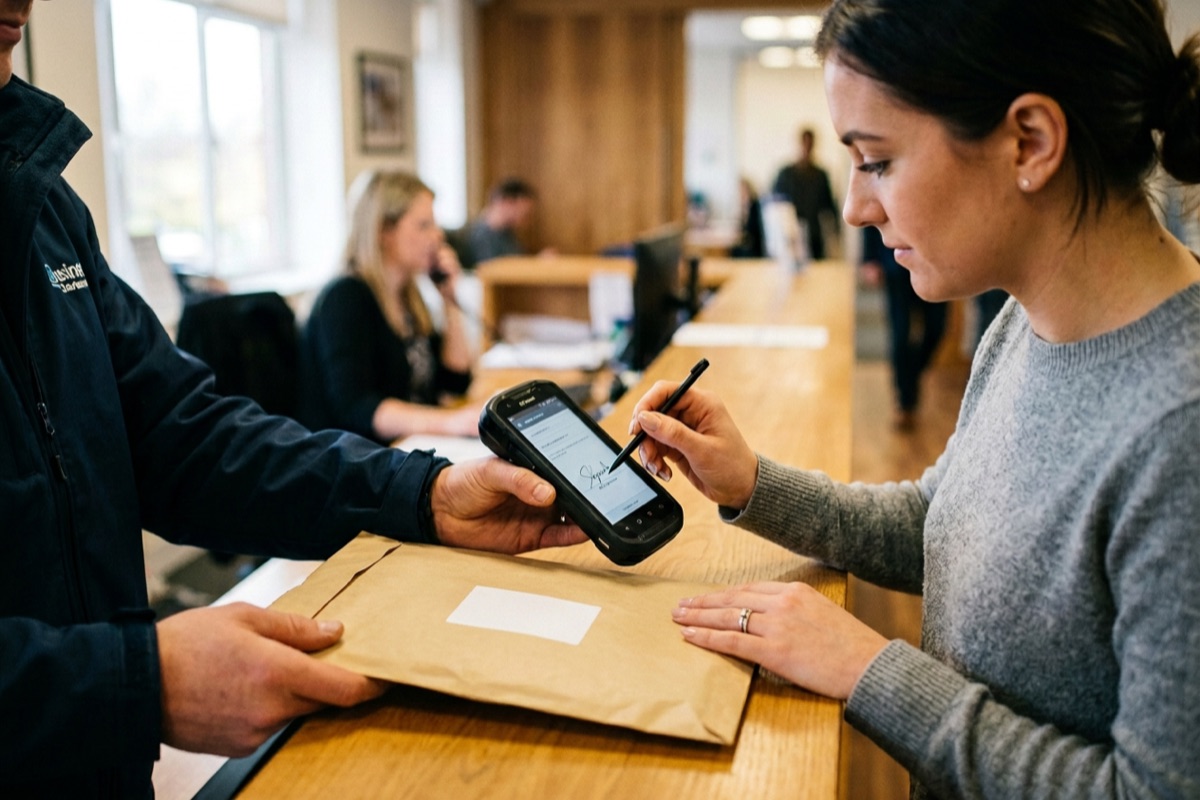
An email server can confirm it accepted a message. That is not the same as proving a named person received and accepted a specific physical item. For contracts, demand letters, compliance notices, original documents and employee records, an independent delivery record is often the whole point of using business mail.
Canada Post Registered Mail supplies a dated mailing receipt, a unique tracking number, the delivery date and a copy of the recipient's signature. A signature is mandatory before the item is handed over. If the recipient refuses to sign, the item comes back to you, and that return is itself evidence.
The trail you end up with: proof the item entered the postal network, tracking tied to a barcode, the delivery date and time, the name and signature of whoever accepted it, and return-to-sender evidence when delivery failed. Courts and regulators have been reading that trail for a long time.
One limit worth stating plainly. Registered Mail proves custody and acceptance. It does not prove the envelope's contents were unchanged. For material where integrity matters, add tamper-evident packaging, restricted internal handling and a retained copy or hash of what you sent.
3. Business mail sidesteps email fraud
Email is indispensable and it is also where the attacks arrive: phishing, spoofed senders, credential theft, account takeover, poisoned attachments and, above all, fake payment instructions. Business mail is a separate channel with a different risk profile, which is exactly why it is useful for the transactions you most need to protect.
A Payments Canada study found one in five Canadian businesses experienced payment fraud in a six-month window and 15% lost money. Impersonation was the most common category at 25%, intercepted business e-Transfers accounted for 22%, and 45% of businesses had noticed more fraudulent or suspicious activity coming through email.
The scale is clearest in U.S. data. The FBI's Internet Crime Complaint Centre logged 21,442 business email compromise complaints in 2024 with about US$2.77 billion in reported losses, rising to roughly US$3.05 billion across 24,768 complaints in 2025. Those are U.S. figures, but the attack class does not respect the border.
The Canadian Centre for Cyber Security tells organizations to encrypt email carrying financial, legal, personal, customer or employee information. Its small-business guide goes further: if unauthorized disclosure could cause serious harm, use another secure method entirely, or encrypt the attachment and send the password by a separate channel.
Paper is a different risk, not a smaller one. Business mail is immune to remote phishing, credential theft and mass digital exfiltration. It is exposed to theft, misdelivery, unauthorized opening, copying and sloppy storage.
The privacy regulator says the same. The Office of the Privacy Commissioner of Canada requires safeguards matched to sensitivity whatever the format, and its guidance specifically tells businesses to verify destination addresses, keep sensitive details out of envelope windows and check that machine-sealed envelopes actually closed.
The rule that matters most. A change to payment details should never be trusted on the strength of one channel, paper or email. Verify through an independently sourced phone number and require two approvals.
Putting those together, here is the business mail and email channel hierarchy we would defend for a small or mid-sized company.
| Information type | Preferred channel |
|---|---|
| Routine, non-sensitive correspondence | Standard email |
| Sensitive digital records that need speed | Authenticated secure portal or properly encrypted transfer |
| Physical originals, or anything needing acceptance evidence | Tracked or Registered Mail with signature |
| Extremely sensitive information | Encrypted portal, or controlled courier or Registered Mail, chosen through a documented risk assessment |
| Changes to payment details | Never one channel alone. Independent phone verification plus dual approval |
4. Direct business mail still earns attention
Email and social ads are cheap to send, which is why inboxes and feeds are saturated. A piece of business mail costs money to print and deliver, and in return it gets a physical presence, precise geographic targeting and a shelf life on a desk or noticeboard that a push notification never has.
Neuroscience research commissioned by Canada Post found direct mail 21% easier to understand and 20% more motivating than email and display advertising. Attention research the corporation cites found 63% of recipients were doing nothing else while looking at a mail piece, and that mail's cost per minute of attention was 40% more efficient than social advertising. Vendor-commissioned, so weigh it accordingly, but the direction matches what marketers keep reporting.
The clearest real-world number comes from fundraising. In the 2025 Canadian Direct Mail Benchmarks, mail produced 61% of participating organizations' fundraising revenue despite the strike, with a 5.59% house-list response rate and 0.67% on acquisition. That is a nonprofit dataset, not an all-industry benchmark, but it shows physical mail can still be a lead revenue channel where the audience suits it.
Big senders are spending more. Lob and Comperemedia surveyed 405 marketers at companies with at least 500 employees for the 2025 State of Direct Mail. Planned average volume rose from 34.9 million pieces per company in 2024 to 67.3 million in 2025. Read that as investment among active enterprise users, not a forecast for total postal volume.
Mail works as a system, not a substitute. A unique QR code, a personalized URL, a campaign phone number or an offer code ties the physical piece to a measurable online action. Without that link you are guessing at attribution.
Where it fits for a small firm. Lapsed customers whose email consent has expired, a tight local radius, and anything where being the only envelope on the desk beats being the fortieth email of the morning.

5. E-commerce runs on physical delivery
Digital commerce does not remove physical delivery. It moves activity out of stores and into fulfilment networks, and every online order for a physical product creates a parcel, and often a return, a replacement or a sample behind it. That flow is the fastest-growing part of business mail.
Statistics Canada reported e-commerce revenue up 9.0% to $73.7 billion in 2024, against 3.0% growth in total retail. South of the border, the Pitney Bowes Parcel Shipping Index put U.S. volume at 22.4 billion shipments in 2024 and 23.1 billion in 2025, up 3.3%.
Canada Post's own numbers need care. Its parcel volume fell 32.6% in 2025 as the labour dispute pushed shippers to other carriers. By the second quarter of 2026 volume was up 15.6% year over year and parcel revenue up 20.7%. That is one carrier recovering lost share, not proof that all parcel demand grew that fast.
The wider point holds either way. Canada Post's share of the parcel market fell from 62% in 2019 to 24% in 2024 while Purolator, UPS, FedEx, DHL, Amazon Logistics and regional couriers expanded. A shrinking Canada Post share says nothing about shrinking demand for delivery. The Canada Post transformation plan is a response to that shift, not a sign that parcels are going away.
The quiet advantage: an address reaches everyone
A postal address is still close to a universal identity layer. To send business mail you do not need the recipient's email, their cooperation with a particular app, an account login, compatible encryption software or a current phone number. You need a valid street or postal address.
In 2025 Canada Post served 17.8 million residential and business addresses, including about 5.7 million on more than 8,100 rural and suburban routes, with scheduled five-day delivery to 99.9% of them. More than half of its nearly 5,800 post offices are rural.
Reach is not the same as speed or reliability. On-time domestic Lettermail was 83.1% in 2025, partly a strike effect, and the corporation lost $1.57 billion before tax. Keep a courier account and a digital fallback. Do not build a process that depends on one carrier.
Where universal reach earns its keep
Customers or suppliers with patchy digital access, and rural, remote or northern locations.
Former customers whose consent for electronic marketing has lapsed or whose email addresses have died.
Identity and address workflows, including returned mail as a signal that a record is stale.
Physical items: replacement cards, keys, certificates, signed originals.
Continuity when a platform, account or email domain is down or locked.
What the data on business mail does and does not support
The evidence backs the statement that business mail and postal services remain essential and commercially relevant in 2026. It does not back the claim that every form of mail is thriving. Claim by claim:
| Claim | Verdict |
|---|---|
| "Postal mail is dead." | False. Canada still processes hundreds of millions of paper payments, about 2.0 billion letters and a large parcel flow. |
| "Business-to-business mail is increasing." | Partly. Transaction mail rose 2.4% in 2025 and small firms remain heavy users, but the rise was temporary and the long-term trend is down. |
| "Businesses are moving back to cheques." | Not established. Cheque value and acceptance stay high; volume keeps falling. |
| "Physical mail is safer than email." | Sometimes, for particular threats. It avoids remote email attacks and adds signatures and tracking, but it introduces theft and misdelivery risk. |
| "Package delivery is growing." | Supported at market level. Canadian e-commerce grew 9.0% in 2024 and U.S. parcels 3.3% in 2025. Individual carriers vary widely. |
| "Direct mail still works." | Supported for suitable audiences. Strong attention effects and material revenue in sectors like fundraising. |
How to run business mail well in 2026
The defensible strategy is hybrid. Match each channel to the risk, the recipient and the job. Email for fast, low-risk traffic and a secure portal for sensitive digital exchange. Business mail when reach, a tangible original, human attention or independent delivery evidence adds value. Registered Mail, signatures and tamper-evident packaging for the high-risk documents. Independent verification for any payment change, whichever channel it arrived on.
The piece most small companies get wrong is intake. Mail that lands in a shared lobby, sits in a pile, or gets opened by whoever is nearest is a privacy problem and an audit problem. A business address with logged receipt, restricted access, prompt scan notifications and clear retention rules turns the physical channel into something you can actually rely on.
That is the service we built. Our virtual office vancouver plans start at $30 a month and give you a real downtown business address at 997 Seymour Street, with mail scanned, forwarded or held for pickup as you choose. A po box vancouver alternative that is accepted for business registration, unlike a post office box. Registered Mail forwarding within Canada is $25 per item and scanning packages start at $40. If you are weighing the options, start with PO box versus virtual office and the business address requirements in Canada.
A business mail checklist
Log everything in. Date, sender, who opened it, where it went. A cheque that vanishes between the mailbox and the bookkeeper is a real loss.
Scan on arrival, decide later. A same-day scan means remote staff act on a notice the day it lands, not the week someone visits the office.
Register what matters. Contracts, notices, originals and anything you might one day need to prove you sent.
Never move money on one channel. Verify new banking details by phone using a number you already had.
Keep two carriers. The 2024 and 2025 disruptions were a rehearsal for the next one.
Watch the delivery model change. Door-to-door is ending for millions of addresses; our post on the future of residential mail delivery in Canada explains what that means for a home-based business.
Quick answers
Is business mail dead in 2026? No. Letter volume has fallen from about 5.5 billion pieces in 2006 to about 2.0 billion in 2025, but Canadian businesses still made 340 million cheque and paper payments worth $2.7 trillion in 2024, and parcels are growing with e-commerce.
Are Canadian businesses going back to cheques and business mail? The data does not show that. Cheques carry 22% of payment value on 2% of volume and are accepted by 70.1% of businesses, but paper volume keeps declining and most firms plan to move to EFT or real-time payments.
Is mailing a document safer than emailing it? Against remote threats like phishing and account takeover, yes. Against theft, misdelivery and unauthorized opening, no. Use Registered Mail with a signature for anything you need to prove was delivered, and never accept payment-detail changes on one channel alone.
What does Registered Mail actually prove? That the item entered the postal network on a given date, that it was tracked, when it was delivered, and who signed for it. It does not prove the contents were unchanged, so add tamper-evident packaging when integrity matters.
Why does a remote business still need a physical mailing address? Government, banks, courts, suppliers and customers still send originals, cheques and notices by post, and a street address is required for business registration in most cases. A managed business address with scanning lets a remote team receive all of it without anyone waiting at an office.
Sources
- Canada Post, 2025 Annual Report: our financial picture and Canadian Postal Service Charter results
- Canada Post, 2024 Annual Report: executive summary (2006 peak-mail figure and parcel market share)
- Canada Post via Newswire, Canada Post reports $1.57 billion loss before tax for 2025 (transaction mail volume change)
- Payments Canada, Canadian payment data for 2024
- Payments Canada, One in five Canadian businesses experienced payment fraud in the past six months
- Statistics Canada, Analysis of payment methods accepted by businesses, 2023
- Statistics Canada, The Daily: Annual retail trade, 2024
- CFIB, Canada Post at a Crossroads: small businesses call for change, 2025
- Canada Post, Registered Mail for small business and Registered Mail delivery requirements
- FBI Internet Crime Complaint Center, 2025 Internet Crime Report
- Canadian Centre for Cyber Security, Email security best practices (ITSM.60.002)
- Office of the Privacy Commissioner of Canada, PIPEDA interpretation bulletin: safeguards
- Canada Post, Connecting for action: direct mail neuroscience study
- CharityVillage, The 2025 Canadian Direct Mail Benchmarks Report
- Lob and Comperemedia, State of Direct Mail 2025
- Pitney Bowes, Parcel Shipping Index 2026
Figures in this article were checked against the linked sources on September 19, 2026. VanCubers prices are current as of the same date.











Leave A Comment