

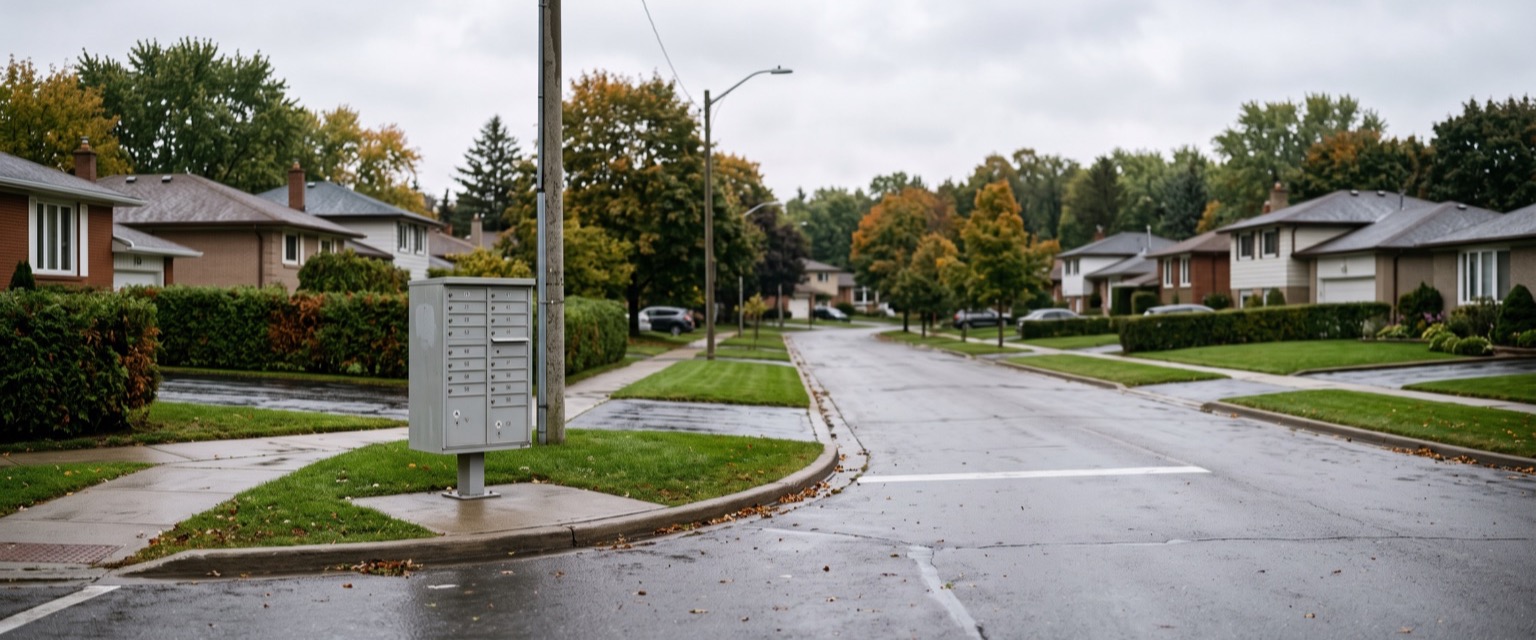
The short version: the Canada Post transformation plan ends door-to-door mail delivery for four million Canadian addresses. It went from a commission report to an approved national program in fourteen months, without a vote. North Vancouver, West Vancouver, Burnaby and New Westminster are in the first waves, converting in 2027.
Four million Canadian households are losing mail delivery to their front door, and the decision was never put to a vote. It was made through a commission report, one ministerial statement, a 45-day deadline, and two corporate press releases. The whole chain took fourteen months.
If you live in North Vancouver, West Vancouver, Burnaby or New Westminster, you are in the first two waves. Most people found out from a news story rather than from any consultation. That is not an oversight. The Canada Post transformation plan was designed to move quickly, and the legal barrier that would have slowed it down was removed on purpose.
This article covers who decided what, when, and on what authority. It does not cover what you should do about it. That is a separate piece.
ON THIS PAGE
- The report that started it
- September 25, 2025: the day the rules changed
- What the Canada Post transformation plan actually authorizes
- The money behind the decision
- April 2026: the first 136,000 addresses
- June 2026: another 485,000
- Why dense urban cores were left out
- Who is pushing back
- What is still undecided
The report that started it
In May 2025, the federal Industrial Inquiry Commission led by William Kaplan delivered its report on the state of Canada Post. The commission had been struck to look at a labor dispute. It came back with a much broader finding, which was that the corporation’s business model no longer worked and could not be fixed by bargaining alone.
The report put a number on door-to-door delivery that has driven every decision since. Serving a door-to-door address costs about $284 a year. Serving a community mailbox address costs about $162. That is roughly 75 percent more to keep mail coming to the front door, and with four million addresses still on door-to-door service, the gap adds up fast.
Kaplan recommended converting those addresses to community mailboxes, ending the moratorium on rural post office closures, loosening delivery standards, and letting Canada Post raise stamp prices more often.
September 25, 2025: the day the rules changed
Joël Lightbound, the Minister of Government Transformation, Public Works and Procurement, accepted every recommendation in a single statement on September 25, 2025.
His language was blunt. He described Canada Post as “effectively insolvent” and said repeated bailouts were not a long-term answer. The government’s own statement that day called the situation an existential crisis and pointed to more than $5 billion in accumulated losses since 2018.
The single most important thing that happened that day was not the rhetoric. It was the removal of a rule.
Since 2015, a federal moratorium had blocked Canada Post from converting any more door-to-door addresses to community mailboxes. That moratorium was put in place after the previous conversion program generated enough public anger to become an election issue. It sat there for ten years and it worked. No conversions happened.
Lightbound lifted it. With that gone, Canada Post no longer needed permission for each conversion. It needed a plan.
The minister also gave the corporation 45 days to produce one.
What the Canada Post transformation plan actually authorizes
Canada Post submitted its plan on November 7, 2025. The government reviewed it and approved it.
The plan runs on four tracks, and it is worth being precise about them because they get conflated in coverage.
Community mailbox conversion. Roughly four million addresses move from door-to-door delivery to community mailboxes. Expected savings are about $400 million a year once the program is finished.
Post office network review. The 1994 moratorium on closing rural post offices was also lifted, covering close to 4,000 locations. Canada Post has said the closures will focus on offices in areas that were rural when they were built and are now suburban. Rural, remote and Indigenous community service is supposed to be protected.
Delivery standards. Non-urgent letter mail can move by ground instead of air. The practical effect is that the delivery window for letter mail stretches from an average of three to four days out to an average of three to seven.
Pricing flexibility. Canada Post can raise stamp rates more frequently than before.
Only the first of those changes what happens at your front door. The rest change how fast the mail moves and where you go to buy a stamp.
The money behind the decision
The financial case is not in dispute, whatever you think of the response to it.
Canada Post has lost more than $5 billion since 2018. It posted a $1.57 billion pre-tax loss in 2025 and followed it with a $205 million loss in the first quarter of 2026. The corporation has been running through roughly $10 million a day. It has taken $2 billion in federal loans over two years and is legally expected to be self-sustaining.
The revenue side explains most of it. Letter mail volume has fallen from 5.5 billion pieces a year in 2005 to about 2 billion now. On the parcel side, where the growth was supposed to come from, Canada Post’s market share dropped from 62 percent in 2019 to below 24 percent. Amazon, Purolator, FedEx, UPS and a long tail of gig couriers took it.
So the corporation is delivering less of the thing it has a monopoly on, and losing the thing it does not.
Canada Post spokesperson Jon Hamilton put the cost argument to CBC in April 2026, saying it takes about twice as much money to serve a door-to-door address as it does a community mailbox address, and that the corporation wants to pay its own bills rather than rely on taxpayers.
Whether $400 million a year fixes a $1.57 billion hole is a fair question. It does not, on its own. It is one of several measures, and it is the one that shows up on your street.

April 2026: the first 136,000 addresses
On April 16, 2026, Canada Post named the first thirteen communities. About 136,000 addresses, converting in late 2026 and early 2027.
Most of the first wave sits in central and eastern Canada. Ottawa carries 30,000 addresses. Etobicoke has 18,000. Moncton and Riverview together account for 19,000. Winnipeg, Sept-Îles, La Prairie and Candiac round out the eastern side.
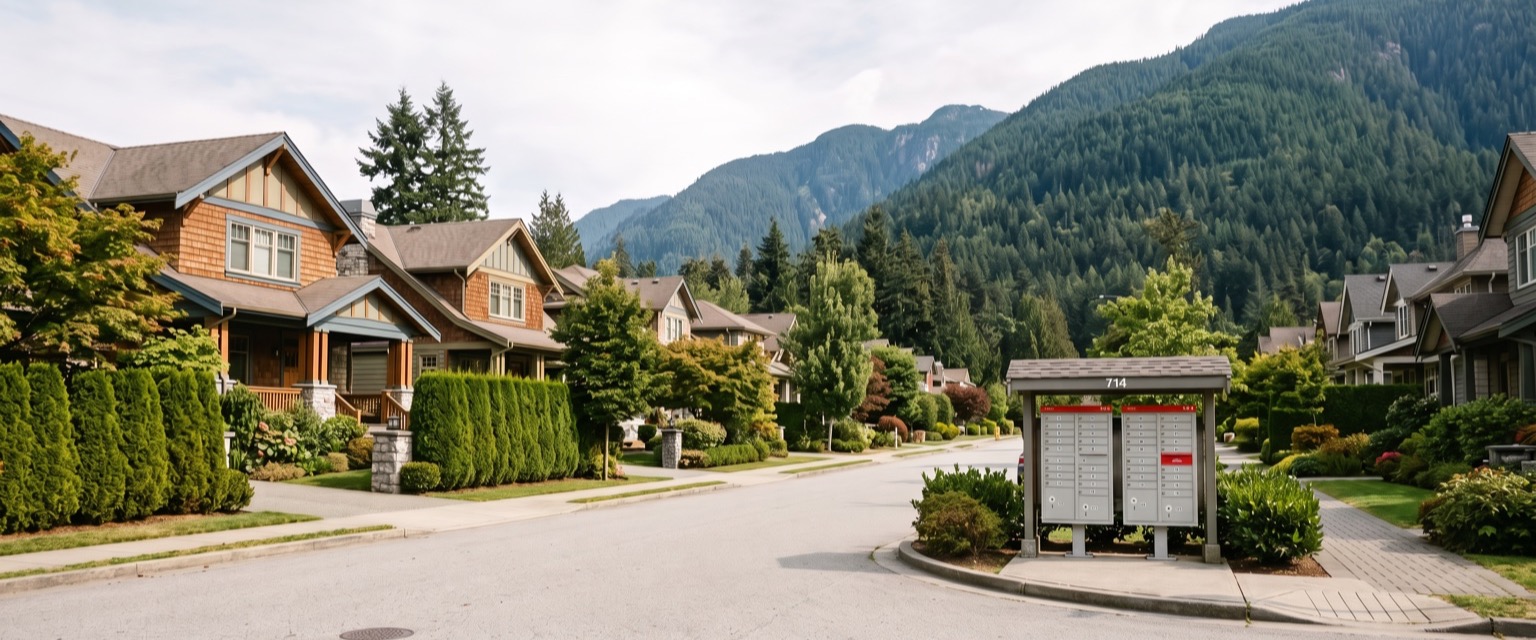
Western Canada appears four times, and three of those are in Metro Vancouver. Abbotsford, Mission, and the City of North Vancouver, District of North Vancouver and West Vancouver treated as one block. The North Shore alone accounts for roughly 23,000 households.
Canada Post’s stated logic for picking these areas first is that they sit next to neighborhoods that already get community mailbox delivery. The infrastructure and the routing are already partly in place.
June 2026: another 485,000
Eight weeks later the program roughly quadrupled.
On June 11, 2026, Canada Post announced 37 more communities and about 485,000 more addresses for conversion in 2027.
British Columbia took 81,000 of them across 16 communities. Burnaby, Coquitlam, New Westminster, Port Coquitlam and Port Moody in the Lower Mainland. Victoria, Saanich, Esquimalt, Langford, Colwood and View Royal on the Island. Kelowna and West Kelowna in the Interior. Songhees Nation and Westbank First Nation lands as well.
Ontario took the largest single share at 158,000. Quebec 139,000. Alberta 56,000.
The current published schedule for BC, taken directly from Canada Post’s own conversion list, reads as follows.
| Community | Postal codes | Anticipated date |
|---|---|---|
| Abbotsford | V2S, V2T | February 2027 |
| Mission | V2V | February 2027 |
| North Vancouver and West Vancouver | V7M, V7P, V7R, V7S, V7T, V7V, V7W | March 2027 |
| Kelowna | V1V, V1W, V1X, V1Y, V1Z | September 2027 |
| West Kelowna | V1Z | September 2027 |
| Burnaby | V3N, V5E | October 2027 |
| New Westminster | V3L, V3M | October 2027 |
| Coquitlam | V3B, V3C, V3E | November 2027 |
| Port Coquitlam | V3B, V3C, V3E | November 2027 |
| Port Moody | V3H | November 2027 |
| Victoria and View Royal | V9A, V9B, V9C | November 2027 |
| Colwood and Langford | V9B, V9C | November 2027 |
| Esquimalt and Saanich | V9A | November 2027 |
Canada Post calls these dates anticipated and says they are subject to change. Treat them as intent rather than commitment. For what actually changes at your address once your postal code comes up, that is covered separately.
Why dense urban cores were left out
Look at the BC table again and something is missing. Vancouver.
No Vancouver postal code appears anywhere in the 2026 or 2027 schedule. Not V5K, not V6B, not V6E, not any of them.
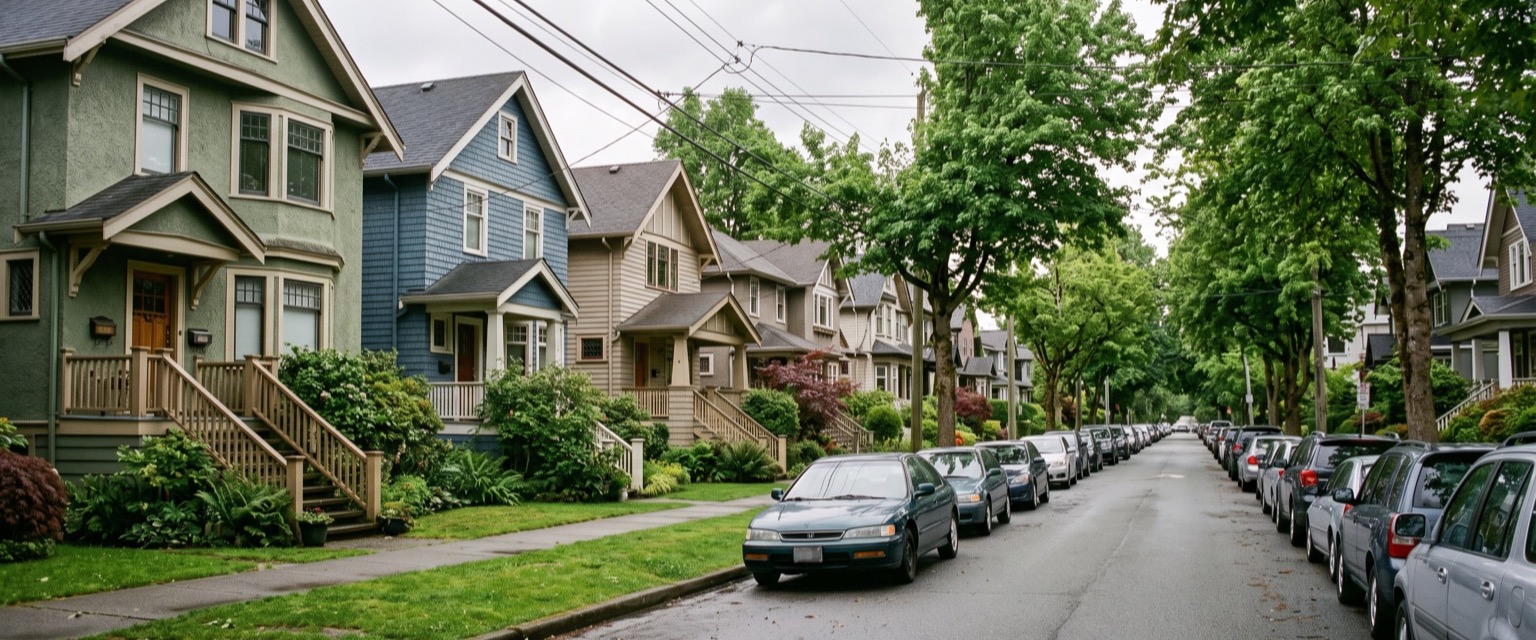
This is deliberate. Canada Post has said that converting dense urban core areas creates additional problems and that those areas will be handled in later stages of the program. The problem is physical. A community mailbox unit needs a footprint, sightlines, and a place to stand that is not a bike lane or a bus stop. On a Vancouver block with laneway houses, no boulevard and a car every four meters of curb, there is nowhere to put it.
That does not mean Vancouver is exempt. The mandate covers all four million door-to-door addresses. It means Vancouver is later and harder. There is a separate piece on whether Vancouver is affected and what “later” is likely to look like.
Who is pushing back
Municipal councils have started to object, though they have little real power here.
New Westminster council raised concerns in July 2026. Mayor Patrick Johnstone said he had heard from residents and had spoken to mayors in Burnaby, Coquitlam, Port Coquitlam and Port Moody who were hearing the same thing. Council asked Canada Post for a balanced approach.
Municipalities do have one real point of influence. Community mailbox locations are finalized in consultation with the local government and have to meet operational and safety requirements. A city cannot stop the conversion. It can argue about where the boxes go, which matters more than it sounds like it does when the alternative is a unit at the far end of a long block.
The Canadian Union of Postal Workers has been the loudest opponent throughout. Its June 2026 fact sheet attacks the Delivery Accommodation Program as limited in scope and hard to navigate, and raises fall risk for older residents crossing snow and ice to reach a box. The union’s members were on rotating strike through late 2025 over these changes. A five-year collective agreement was ratified in late May 2026, which removed the main labor obstacle to the June expansion.
What is still undecided
Three things are genuinely open.
The timeline. Canada Post says five years. Lightbound said it could take up to nine, with the bulk in the first three to four. Those are not the same number, and the gap matters if your postal code is not yet listed.
Where the boxes go. Siting is being worked out community by community, right now. This is the part residents can actually influence, and the window closes once a site is finalized.
Whether the savings hold. The $400 million figure is a projection based on the cost gap between the two delivery models. It assumes conversion costs stay contained and that mail volume does not fall faster than expected. Neither is guaranteed.
What is not open is the direction. The moratorium is gone, the plan is approved, the first sites are being surveyed, and the corporation has a mandate to be self-sustaining by 2030. Door-to-door residential mail delivery in Canada is ending, and the remaining questions are about pace and placement.
For what that means over the next decade, see where residential mail is heading.
Common questions
Who decided to end door-to-door mail delivery in Canada?
The federal government. Minister Joël Lightbound accepted the recommendations of the May 2025 Industrial Inquiry Commission on September 25, 2025, and lifted the 2015 moratorium that had blocked further community mailbox conversions. Canada Post then submitted a transformation plan on November 7, 2025, which the government approved.
How many addresses are affected by the Canada Post transformation plan?
About four million addresses across Canada. Roughly 136,000 were named for conversion in late 2026 and early 2027, and another 485,000 for 2027.
How much money does the community mailbox conversion save?
Canada Post projects about $400 million a year once the full conversion is complete. The May 2025 Industrial Inquiry Commission put the cost of serving a door-to-door address at roughly $284 a year, compared with $162 for a community mailbox address.
How long will the conversion take?
Canada Post has said about five years. Minister Lightbound has said it could take up to nine, with most of the work in the first three to four years.
Can a city stop Canada Post from installing community mailboxes?
No. Municipalities are consulted on where community mailbox sites are located and can raise operational and safety concerns about specific placements, but they cannot block the conversion itself.
Sources
- Government of Canada, Government of Canada instructs Canada Post to begin transformation, September 25, 2025
- Canada Post, Canada Post expands community mailbox conversions to additional communities in 2027, June 11, 2026
- Canada Post, The move to community mailboxes: postal codes scheduled for conversion
- CBC News, Canada Post announces 136,000 new addresses to lose door-to-door delivery, April 2026
- CBC News, Canada Post announces 485,000 more addresses to lose home delivery, June 11, 2026
- Global News, Canada Post can end door-to-door delivery, close some offices, Ottawa says, September 25, 2025
- North Shore News, Canada Post to cut door-to-door delivery for 23,000 North Van, West Van households, April 2026
- Freshet News, New Westminster urges Canada Post to take a balanced approach to mailbox conversions, July 2026
- CUPW, Community Mailbox Conversion fact sheet, June 2026
- C.D. Howe Institute, Untying the Gordian Knot: Reforming Canada’s Postal Market, June 2026
Facts in this article were verified against primary sources on August 27, 2026. Canada Post describes its conversion dates as anticipated and subject to change.

Leave A Comment