


The short version: the future of residential mail delivery in Canada is centralized, slower and smaller. Letter volume is down 64 percent since 2005, parcel share has fallen below 24 percent, delivery to the door is ending for four million addresses, and the letter mail that remains is disproportionately the kind with deadlines attached.
Community mailboxes are getting all the attention, and they are the least interesting part of what is happening.
The future of residential mail delivery in Canada is being set by numbers that have been moving in one direction for twenty years. Letter volume down. Parcel share down. Cost per address up. Losses compounding. The conversion of four million addresses is a response to those numbers, not a cause of anything.
Six shifts are already in motion. Some are locked in, one is genuinely open, and a couple have consequences that have not been thought through in public yet.
If you want the specific decisions and dates behind the current program, that is the decision trail. This piece is about direction rather than schedule.
ON THIS PAGE
1. Letter mail is not declining, it has declined
Canadians sent about 5.5 billion pieces of letter mail a year in 2005. The figure now is around 2 billion.
That is a 64 percent drop, and it is worth being clear about what it represents. This is not a business softening. This is the near-total migration of routine correspondence to email, banking apps, government portals and text messages. Bills, statements, notices, receipts and most personal mail have already left. They are not coming back if Canada Post improves service.
What remains in the letter stream is a smaller, stranger mix. Government correspondence that has legal weight. Financial and insurance notices that carry deadlines. Legal service. Cheques, which persist far past their expiry date in Canadian business. Election material. And a lot of unaddressed advertising mail, which is one of the few product lines still paying its way.
The letters left in the system are disproportionately the ones with consequences attached. That is the detail that makes the rest of this matter.

2. Canada Post lost the parcel war
The recovery plan for every legacy postal service in the world was the same. Letters die, parcels grow, e-commerce saves us.
Canada Post held 62 percent of the domestic parcel market in 2019. That figure is now below 24 percent.
The share went to Amazon’s own logistics network, to Purolator, UPS, FedEx, Intelcom and a long tail of contracted gig couriers who deliver at costs a unionized Crown corporation cannot match. Labor disruption accelerated it. Every strike and rotating job action in 2024 and 2025 pushed shippers to alternate carriers, and shippers who switch rarely switch back.
The strategic consequence is that Canada Post cannot cross-subsidize the letter obligation with parcel profit. That was the entire plan. It failed, and everything in the current transformation follows from that failure.
The corporation lost more than $5 billion between 2018 and 2025, including a $1.57 billion pre-tax loss in 2025 and another $205 million in the first quarter of 2026.
3. Delivery is becoming centralized by default
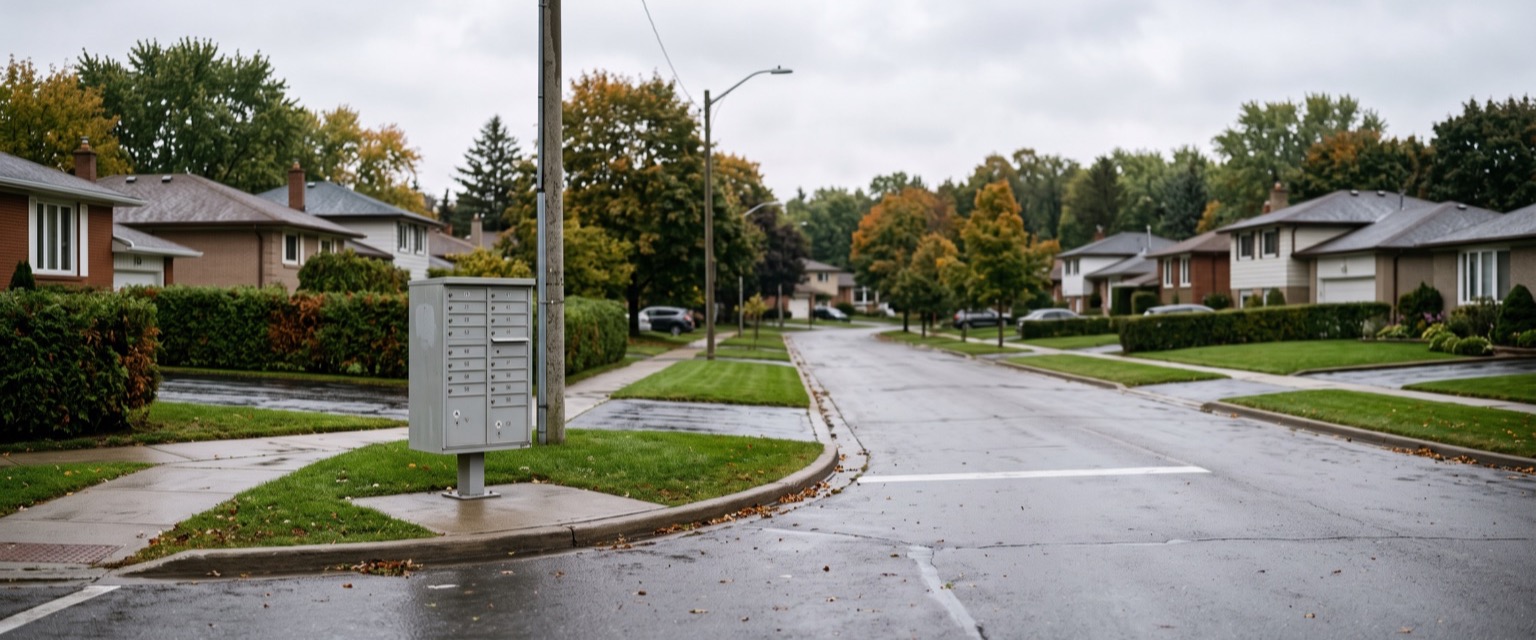
Nearly three quarters of Canadian addresses already receive mail through centralized delivery. Community mailboxes, apartment lobby panels, rural mailbox banks.
The current conversion program takes that to effectively 100 percent over five to nine years. Once it finishes, delivery to an individual residential door will be an accommodation granted on application rather than a standard service.
That is a real change in what a postal service is. For most of the last century the mandate was to bring the mail to the person. The emerging mandate is to bring the mail to a secure point near the person and have the person come to it. The cost argument is straightforward: the May 2025 Industrial Inquiry Commission put door-to-door service at roughly $284 per address per year against $162 for a community mailbox.
Two second-order effects are already visible.
New construction has been building centralized delivery in for years. Any subdivision built in BC since the 1980s has community mailboxes. The conversion program is really about older neighborhoods catching up to a standard that has been default for four decades.
And density resists it. Canada Post has said dense urban cores are harder and come later, which is why Vancouver was skipped while the North Shore goes in March 2027. There is a plausible end state where the last door-to-door delivery in Canada is in a downtown core, purely because there is nowhere to put a box. For homeowners already scheduled, what changes at your address is worth reading before the notice arrives.
4. Speed is now a variable, not a standard
Under the changes accepted in September 2025, non-urgent letter mail can move by ground instead of air. Average delivery times go from three to four days out to three to seven days.
The requirement to deliver five days a week was also loosened.
Read those two together and the shape of the future service becomes clear. Letter mail is being reclassified as non-urgent by default, with speed available at a price for anyone who needs it. That is how private couriers have always worked and it is how most reformed postal services in Europe now work. Denmark ended letter delivery entirely at the end of 2025. The Netherlands, New Zealand and parts of the Nordics have all cut delivery frequency substantially.
The problem is that Canadian institutions have not repriced their deadlines. A CRA notice, an ICBC renewal, a strata levy, a court filing deadline: those clocks were set when mail took three days and arrived at your door. If mail now takes seven days and lands in a box you check occasionally, the effective response window has been cut roughly in half without anyone amending a single deadline.
Nobody has addressed this. It is the quiet risk in the whole program.
5. The retail network is shrinking
The 1994 moratorium on closing rural post offices covered close to 4,000 locations. It was lifted in September 2025.
Canada Post has also started reviewing urban and suburban post offices it considers over-served, with a view to closing some. The corporation’s stated position is that rural, remote and Indigenous community service will be protected, and that closures will focus on offices in places that were rural when they were built and have since become suburban.
That framing is doing some work. A rural post office that is now surrounded by subdivisions is exactly the kind of location where a lot of people rely on the counter.
The practical effect for households is that the fallback options are narrowing at the same time as the primary service does. Oversized parcels get held at a post office. A post office box is one of the standard answers to losing door-to-door delivery. Both of those assume a nearby branch that stays open.
6. The mailbox is becoming a notification problem
This is the shift with the least coverage and the most day-to-day consequence.
A mailbox attached to your house is a passive notification system. You do not check it. You pass it on the way in, see something in it, and take it. The system works because it costs no attention.
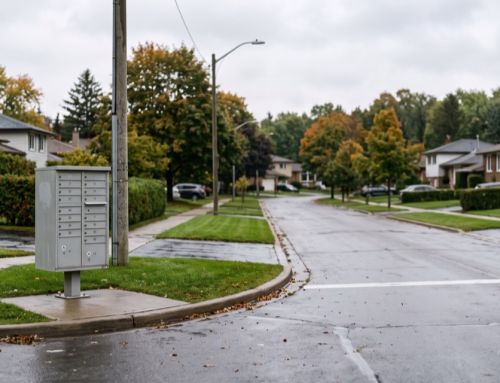
A community mailbox breaks that. It is not on the path between your car and your door, so checking it becomes a deliberate act that competes with everything else in your day. Canada Post does not notify you when anything arrives. Not for letters, and not for parcels. A parcel compartment key goes into your personal slot, where you can only find it by having already gone to check.
The result is that mail piles up. Not because anyone is careless, but because the trigger that used to prompt the check is gone. A week becomes three. And the mail sitting in there is, as noted above, increasingly the subset that carries deadlines.
This is the gap the market fills, and it is already happening. Amazon Lockers, parcel rooms in new buildings, PO boxes with email alerts, and staffed mail services all exist because centralized delivery removed the notification and something had to replace it.
Expect Canada Post to eventually add arrival notifications, because the technology is trivial and the demand is obvious. It is not part of the current program.

What nobody has settled yet
Whether the savings materialize. The $400 million annual figure is a projection. It assumes conversion costs stay contained across four million addresses, and that letter volume does not fall faster than modeled. Volume has consistently fallen faster than modeled for twenty years.
What the universal service obligation means afterward. The Canadian Postal Service Charter commits Canada Post to serving every address. It has not been amended to define what “serving” means once delivery to the door is gone. That definition is being set operationally, one conversion at a time, rather than legislatively.
Whether anyone fixes the deadline mismatch. Federal and provincial agencies still mail time-limited notices on the assumption of prompt door delivery. That assumption is now wrong in most of the country, and no agency has publicly adjusted for it.
What happens to the last mile. If Canada Post’s parcel share keeps falling and the letter stream keeps shrinking, the question stops being how mail is delivered and becomes whether a national letter carrier is the right structure at all. The C.D. Howe Institute published an argument for broader postal market reform in June 2026 that goes considerably further than anything the government has proposed. That debate is coming, probably in the next mandate.
The direction of all six shifts is the same. Less mail, delivered less often, to a point near you rather than to you, from a network with fewer counters. Households that depend on catching a specific piece of paper on a specific day are going to need something between them and that system.
That is the reason we built Smart Mailbox the way we did. Mail gets scanned and emailed the day it arrives, parcels get accepted and signed for from any courier, and the physical mail is held for pickup or forwarded on your preference. The address matters less than the fact that something arriving produces a message rather than silence. It does not replace a residential address for a driver’s license, voter registration or CRA purposes, and it is not meant to.
Common questions
What is the future of residential mail delivery in Canada?
Centralized, slower and smaller. All four million remaining door-to-door addresses are scheduled to convert to community mailboxes over five to nine years, letter mail delivery standards have stretched from an average of three to four days to three to seven, and Canada Post is reviewing its post office network for closures.
How much has Canadian letter mail volume declined?
From about 5.5 billion pieces a year in 2005 to about 2 billion now, a drop of roughly 64 percent.
What is Canada Post’s share of the parcel market?
Below 24 percent, down from 62 percent in 2019. The share went to Amazon’s own network, Purolator, UPS, FedEx and contracted courier services.
Will Canada Post notify me when mail arrives in a community mailbox?
No. There is no arrival notification for letter mail or parcels in the current program. A parcel compartment key is left in your personal mail slot, which you only see once you go and check.
Are post offices closing in Canada?
The 1994 moratorium on closing rural post offices, covering close to 4,000 locations, was lifted in September 2025. Canada Post is also reviewing urban and suburban locations it considers over-served. It has said rural, remote and Indigenous community service will be protected.
Sources
- Government of Canada, Government of Canada instructs Canada Post to begin transformation, September 25, 2025
- Canada Post, Canada Post expands community mailbox conversions to additional communities in 2027, June 11, 2026
- The Globe and Mail, These are the first postal codes Canada Post is converting to community mailboxes, April 2026
- CBC News, Canada Post announces 485,000 more addresses to lose home delivery, June 11, 2026
- Canadian Press via Rocky Mountain Outlook, Canada Post set to reduce frequency of letter mail delivery, September 25, 2025
- C.D. Howe Institute, Untying the Gordian Knot: Reforming Canada’s Postal Market, June 2026
- Global News, Canada Post can end door-to-door delivery, close some offices, Ottawa says, September 25, 2025
Facts in this article were verified against primary sources on August 27, 2026.


Leave A Comment