


If you are asking should I use my home address for business, you have probably already done it. Most founders type their home into the registration form in thirty seconds, get the confirmation email, and only start searching weeks later when a piece of business mail arrives addressed to the company, at the apartment, with their name visible through the window. The good news: using your home was almost certainly legal. The honest news: legal and smart are different questions, and there are four specific ways the home address costs you later. All four have cheap fixes, and the earlier you make them, the cheaper they are.
ON THIS PAGE
- Risk 1: anyone can look up where you live
- Risk 2: the credibility discount
- Risk 3: your front door becomes a legal address
- Risk 4: the mail you never read
- Who actually sees your address
- Three composite stories
- The quiet fifth issue: zoning and strata rules
- The low-cost fix, and how to switch
- Common questions
THE SHORT ANSWER
Legal, yes, almost everywhere in Canada. Smart, rarely, once the business is incorporated or public-facing. The question is not whether the form accepts your home address. It is whether you want your home published in a government database, printed on invoices, standing in for a staffed office, and receiving the one letter a year that can dissolve your company. Should I use my home address for business has a short answer: only if none of those four sentences bothers you.
Risk 1: Anyone Can Look Up Where You Live
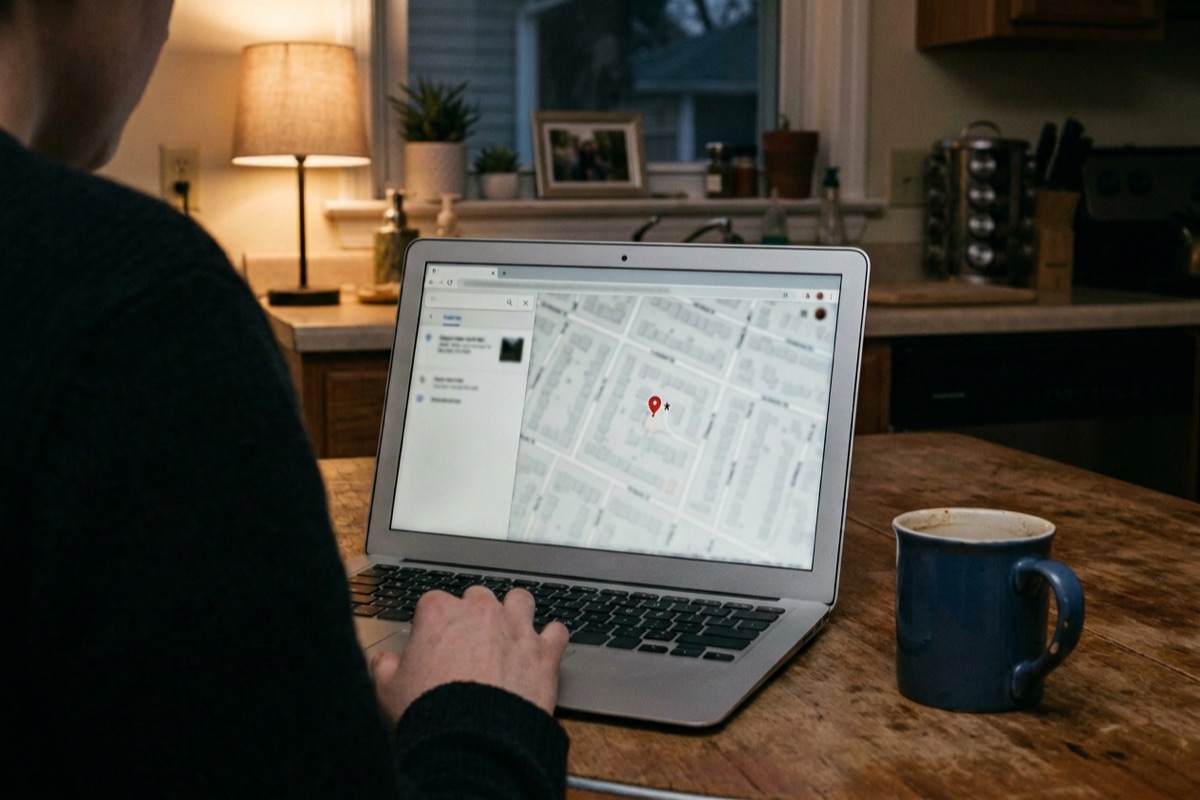
This is the first of the risks of using home address for business that founders discover, and the one that is hardest to undo. When a corporation files its registered office, Corporations Canada's own Form 2 instructions carry the caution in plain words: the address, even when residential, is public and published in the online database. BC Registries says the same about its registered and records office addresses. Director addresses are public too.
Public means searchable by anyone with your company name: a difficult customer, a competitor, an ex, a stranger on the internet who did not like your product review response. There is no access log and no notification. You will never know who looked.
The exposure compounds because filings are historical. Change the address next year and the change is filed, but the record of what you filed first does not stop having existed. Business address privacy Canada wide works one way: what enters a registry stays findable.
Directors have a built-in fix almost nobody uses: the same federal form allows a non-residential address for service instead of a home address. If you sit on your own board, use it. It is free and it is sitting right there on the form.
Risk 2: The Credibility Discount
No statute covers this one, so we will state it as what it is: pattern, not law. A B2B client comparing two quotes looks up both companies. One resolves to a downtown suite, the other to a basement unit in a residential crescent. Nobody says anything. Something is quietly decided anyway.
The same discount applies with landlords running credit checks on commercial tenants, with procurement teams that require a business address on vendor forms, and with investors doing the ten-minute sniff test before a first call. None of them will tell you the address mattered. The risks of using home address for business are mostly like this: invisible, deniable, and priced in without a conversation.
Weigh the business address privacy Canada trade-off against your actual customers. Selling handmade goods to consumers, the discount is near zero. Selling services to companies, it is real, and it costs more than the $30 a month that removes it.
Risk 3: Your Front Door Becomes a Legal Address
A registered office is not decorative. It is the location where legal documents are served on your company, and Corporations Canada's instructions state the consequence plainly: documents sent there are legally assumed to have been received. Deadlines to respond start on delivery, not on the day you happen to read the envelope.
File your home and that machinery points at your door. A process server can arrive during dinner. In BC, the rule is stricter still: the delivery address must be accessible to the public between 9 a.m. and 4 p.m. on business days. If you are at a client site, a day job or a school pickup on a Tuesday afternoon, your home does not actually meet the standard it was filed under. Nobody audits this. It just fails on the one day it is tested, which is the worst available day.
The composite story we hear, with the details changed: a contractor incorporates using the apartment, works out of a truck all day, and a payment dispute turns into a claim served at the apartment while everyone is out. The clock ran anyway. The first the founder heard of it was a default judgment. Nothing in that chain was unusual except the address.
Risk 4: The Mail You Never Read
Should I use my home address for business mail from the government? This risk is the answer. Registries and the CRA send the mail that matters to the addresses on file. The single most expensive version of this risk in BC: annual report reminders and dissolution warnings go to the registered office mailing address, and a company whose filings lapse for two years can be dissolved by the registrar. We documented the full mechanism, deadlines and restoration costs in how a BC company gets dissolved without anyone noticing.
The home address fails here in slow motion. You move apartments and forget the registry. The letter goes to the old unit. Or it arrives at the right unit and sits in the flyer pile, because government envelopes to your home do not look like company emergencies. Should I use my home address for business is, in this risk, really a staffing question: is anyone at that address whose job is to read what arrives? At home, the answer is no. There is only you, and you are busy.
Who Actually Sees Your Address, and When
The exposure is easier to weigh once you list the audiences one by one, because each arrives at a different moment and few of them ever announce themselves.
Registry searchers see it forever, from the day you incorporate. That audience includes anyone with a browser: clients doing due diligence, competitors mapping the market, and strangers with grudges. Everyone you invoice sees whatever address sits in the invoice footer, and invoices get forwarded, filed and screenshotted far beyond the person you sent them to. Couriers and their tracking pages tie your shipments to the address on the label, visible to whoever holds the tracking number.
Directory and map services are the multiplier. Once an address appears on a website contact page, aggregators copy it into listings you never created and cannot easily edit, and a residential pin on a map tells its own story. Lenders, landlords and procurement teams see it at exactly the moments money is being decided, which is the audience the credibility discount is priced by.
Now notice what the business address privacy Canada list is not: it is not hackers or data breaches. Every audience above sees your address because ordinary paperwork showed it to them, lawfully. That is what makes the question of should I use my home address for business worth settling before the first form rather than after the fiftieth. There is nothing to breach when the public fields never contained your home to begin with.
Three Composite Stories From the Mailbox Desk
The risks of using home address for business are abstract until they happen to someone. These are patterns, not clients: composites of the situations that walk in after the fact, with every identifying detail changed. They are worth reading because each one started with the same thirty-second decision this article is about, and each one answers should I use my home address for business more vividly than a statute can.
The reviewer. An online seller leaves a firm reply to an unfair review. The reviewer, still angry, searches the corporate registry, finds the registered office, and posts the seller's home address in a public forum alongside the review. Nothing illegal happened at any step. The address was public information because the seller filed it that way, and no amount of moderation gets it back.
The mover. A consultant incorporates from a rented condo, then moves twice in three years and updates everything except the registry. The annual report reminders go to an address two tenants back. The company is dissolved by the registrar without a single email, and the consultant finds out when a client's accounts payable team cannot verify the corporation exists. Restoration costs more than a decade of commercial mailbox fees.
The landlord's letter. A founder runs a growing operation from an apartment, with the address on invoices, packaging and a busy website. The building's strata council notices the courier traffic and sends a bylaw letter. The business is fine, but the negotiation about what may happen inside the unit now involves people who were never meant to be in the org chart.
Different risks, same root: the risks of using home address for business all trace back to one address doing jobs it was never staffed for.
The Quiet Fifth Issue: Zoning and Strata Rules
Everything above concerned paper. This risk concerns your lease and your neighbours, and it is the one this article will treat most carefully, because the rules are local and we have not verified any one city's bylaws for this post.
Municipalities regulate home-based businesses, and strata corporations layer their own bylaws on top: limits on employees working in a dwelling, on customer visits, on signage. The rules vary by city and by building, so we will not quote specifics here; check your municipality and your strata bylaws directly. The relevant point for this article is simpler. The more loudly your home address advertises that a business operates there, on registries, invoices and your website, the more likely those conversations ever start. A commercial address keeps your paperwork pointing somewhere zoned for exactly what you are doing. If you operate in Vancouver proper, the business licence address rules are their own subject.
The Low-Cost Fix, and How to Switch
None of this argues that home-based business is a mistake, and asking should I use my home address for business does not mean the answer is a hard no everywhere. Working from home is how most Canadian companies begin, and the CRA's own address structure expects it. The argument is narrower: the address you work at and the address the world sees do not have to be the same address, and separating them is the entire fix.
All four risks share one fix: point the public and legal fields at a staffed commercial address, and keep your home for the one field where it is genuinely correct, the CRA physical address of a business that operates from home. The full field-by-field map lives in our pillar guide to business address requirements Canada.
| Risk | What triggers it | The fix |
|---|---|---|
| Public exposure | Registered office and director filings are published | Commercial registered office; address for service for directors |
| Credibility discount | Clients and lenders looking up your address | A street address that resolves to an office |
| Service at your door | Registered office receives served documents, assumed received | A location staffed 9 to 4 on business days |
| Unread registry mail | Reminders and dissolution notices to an unmonitored address | Mail receipt with same-day scanning |
So, should I use my home address for business? By now the honest answer is: only in the fields where it is true, and never in the fields that are public or legal-facing. The switch itself is a filing, not a renovation. Federally, directors can change the registered office within the province and must notify Corporations Canada within fifteen days, under section 19 of the CBCA. BC files a notice of change with the Corporate Registry. Then update the CRA mailing address, the bank, and your own website footer, in that order, and the home address is out of everything except the one private field where it belongs.
Do the switch in one sitting and in this order: registry first, because it has statutory deadlines, then the CRA mailing address, then the bank, then your website, invoice template and email signature. Each step is minutes. The reason to batch them is the same reason the risks existed: scattered addresses in scattered databases are how a company loses track of where it officially lives.
The cost of the fix is the part that surprises people: a staffed downtown mailbox starts at $30 a month on an annual term, with scanning on the next tier up. Against the four risks above, that is the cheapest insurance any of them will ever be. If you are weighing the box-versus-office version of this decision, we priced it out in PO box vs virtual office.
By Jeremy Smillie, VanCubers
Published August 19, 2026. Last updated August 19, 2026. Reviewed by a human before publication.
This article is general information about Canadian business registration requirements, current as of the date shown above. It is not legal, tax or accounting advice, and it does not account for your specific circumstances. Statutes and registry practices change. Confirm requirements with your provincial registry, Corporations Canada or a qualified professional before you file.
Common Questions
Should I use my home address for business registration?
Only if you accept four trade-offs: the address becomes public on corporate registries, clients can see it resolves to a residence, legal documents can be served at your door and are assumed received, and registry mail arrives somewhere nobody monitors during work hours. Most incorporated founders are better served by a commercial address for the public fields.
Is my home address public if I incorporate in Canada?
Yes, if you file it as the registered office. Corporations Canada publishes registered office addresses, residential or not, in its online database, and BC Registries states its registered and records office addresses are public information. Director addresses are public as well, though a non-residential address for service can stand in for a director's home.
How do I remove my home address from the corporate registry?
File a change of registered office to a compliant commercial address. Federally, the change must be reported to Corporations Canada within fifteen days; BC files a notice of change with the Corporate Registry. The going-forward record updates, but the historical filing has already been public, which is why switching early matters.
What are the risks of using a home address for business?
Four main ones: public exposure of where you live through registry databases, a credibility discount when clients and lenders look the address up, legal service arriving at your front door with deadlines that run whether or not you are home, and time-sensitive registry mail landing in a household flyer pile instead of with staff whose job is to read it.
Does a virtual office actually fix the privacy problem?
For the public fields, yes. A staffed commercial address fills the registered office and public-facing fields, so registries and websites show an office instead of your home. Your home can then stay confined to the CRA physical address, which is not public. What it cannot do is erase filings that were already published.











Leave A Comment