

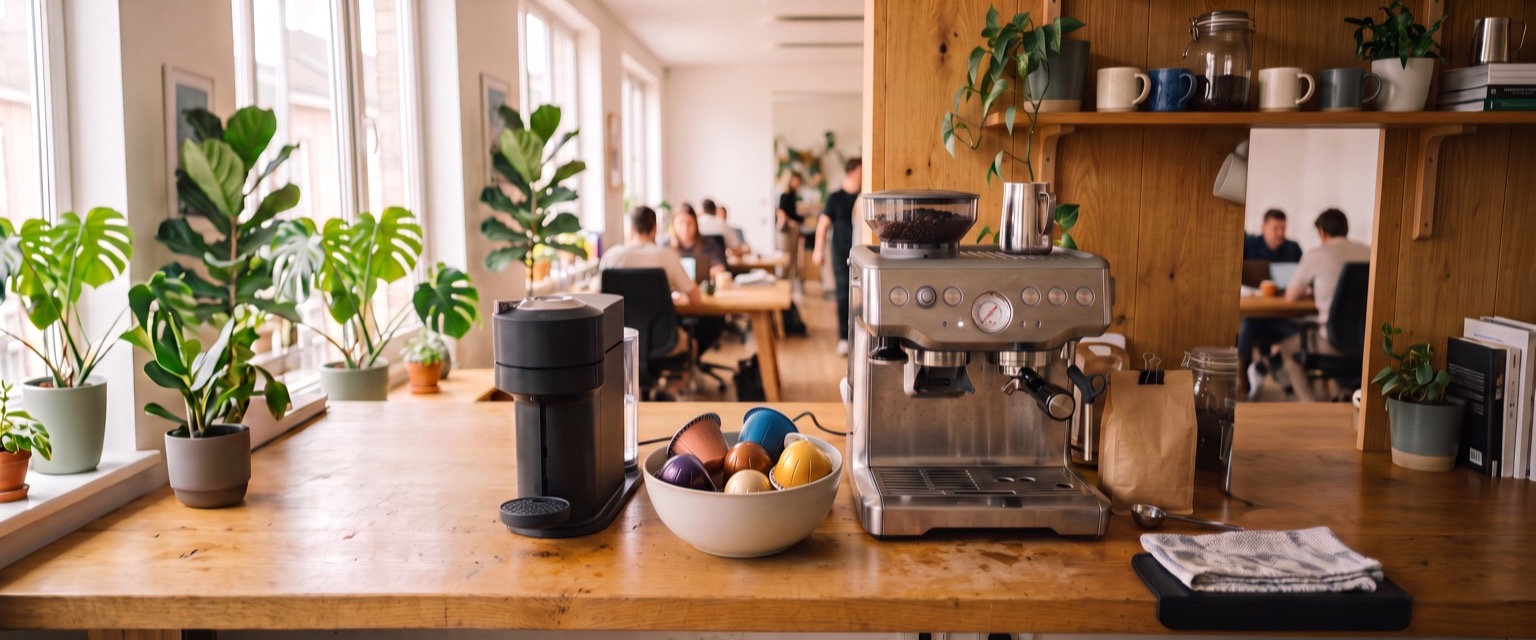
For three years our members have had two ways to make office coffee. On the left of the kitchen counter sits a one-button Nespresso Vertuo with eight to ten capsules to choose from. On the right sits a Breville Barista Express loaded with premium beans, where you grind, dose, tamp, pull the shot, knock out the puck and wipe down. We expected people to argue about which machine made better office coffee. Instead they quietly sorted themselves into two routines, and the thing that decided which routine they picked had surprisingly little to do with how good the coffee in the cup actually was.
ON THIS PAGE
- Two office coffee machines, two routines
- The office coffee paradox
- Why office coffee matters more in Canada right now
- Why "inconsistent" means two different things
- Eight office coffee modes, and which one you are
- The office coffee break matters as much as the cup
- What we are changing at the office coffee station
- Quick answers
Two office coffee machines, two routines
The capsule machine attracted the people who wanted a drink now and wanted to be back at their desk in ninety seconds. They pressed a button, dropped the capsule in the recycling bin, and left. Over three years no single capsule became a favourite, and the most common comment was that the coffee was "weak" or "inconsistent". They kept using it anyway.
The espresso machine attracted a smaller, loyal group. They took four or five minutes, they made a mess more often than they would admit, and a lot of the shots were visibly wrong: too fast, too slow, channelled, under-dosed. They stayed loyal and they cited taste. A few of them went further and started chasing the perfect shot, adjusting grind and dose the way a hobbyist does at home.
To be clear about what this is: three years of watching a real office coffee station, not a controlled study. Nobody logged who used which machine, at what time, with which capsule or how old the beans were. It is a field observation that generated a hypothesis, and the research below is what made us take the hypothesis seriously.
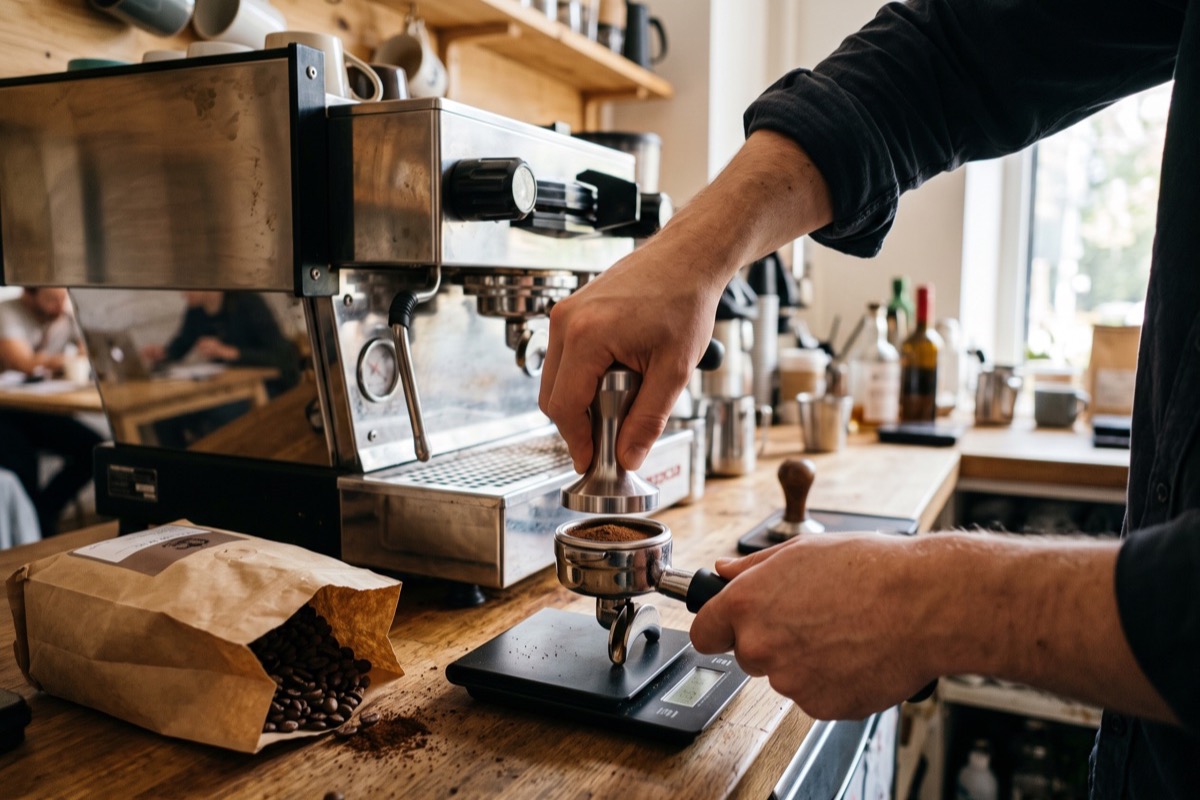
Office coffee is not a contest between good coffee and bad coffee. It is a trade-off between effort, control, sensory reward, speed and confidence, and different people weigh those differently at different times of day.
What that means for an operator. The best office coffee program does not force everyone to agree on one definition of good. It offers an easy path and a craft path, and makes each one hard to misuse.
The office coffee paradox
The technically consistent machine got called inconsistent. The technically inconsistent machine earned loyalty. Four things explain that, and they all operate at once.
| What is happening | Why it favours the espresso machine |
|---|---|
| Concentration beats precision | A badly pulled espresso is still concentrated. Add milk or water and it reads as "strong" next to a 230 ml capsule coffee, even though strong, intense, bitter and high-caffeine are different things. Nespresso itself notes that capsule intensity is a flavour rating, not a caffeine measure. |
| Making it yourself adds value | Research on preparation rituals found people would pay more for coffee made with a visible ritual even when measured enjoyment did not change. Participation counts on its own, separate from what is in the cup. |
| Users self-select | Anyone who hated the process gave up in week one. The people left at the Breville are exactly the people who tolerate effort, so their loyalty tells you nothing about how the whole membership would vote in a blind tasting. |
| Taste is learned | Connoisseurship builds through repetition, comparison and conversation. The members chasing a perfect shot are not a personality type; they are getting better at noticing. |
Why office coffee matters more in Canada right now
Coffee is the one amenity that reaches almost everyone. In the Coffee Association of Canada's winter 2025 survey, 71% of adults had drunk coffee the previous day, 45% a traditional brew and 29% an espresso-based drink. Espresso drinks are climbing: 30% of adults had one the previous day in the 2024 data, up from 24% the year before, and a fifth of past-day cups were cold. An office that offers only a hot mug is quietly missing a third of its people.
Price is the other pressure. Statistics Canada reported grocery coffee up 27.9% year over year in August 2025, with roasted and ground coffee up 35.2%. In the same industry survey, eight in ten adults had noticed the increase and 31% had cut back on coffee bought out of the house. Included office coffee has become a small, visible piece of daily value, and people notice when it is bad.
Read the numbers carefully. The consumption figures are industry survey estimates, not government statistics. The price figures are official. Both point the same way: more people want espresso, and more people care what the office cup is worth.
Why "inconsistent" means two different things
This is the part that changed how we run the office coffee station. The Vertuo reads a barcode on each capsule and sets cup size, temperature, spin speed and contact time on its own. As a process it is about as repeatable as office coffee gets. The Breville exposes every variable to the user: grind, dose, distribution, tamp, yield, time. Published espresso research found grind-related factors alone explained 87 to 96% of the variance in extraction, and the Specialty Coffee Association's survey of 275 baristas shows why professionals weigh everything: an 18 to 20 gram dose, a 1:2 ratio, 25 to 30 seconds, with 82% measuring output on a scale.
So how did the repeatable machine earn the "inconsistent" label? Because members were describing the menu, not the machine. A mild 230 ml coffee, a dark double espresso and a flavoured capsule are deliberately different products. Displayed as ten equivalent "flavours", they promise small variations and deliver big differences in size, strength and mouthfeel. Process consistency was fine. Experience consistency was not.
Process consistency: does the machine repeat its programmed extraction? The capsule machine wins easily.
Experience consistency: does each choice deliver the strength, size and flavour the person expected? A ten-capsule wall fails this even when every capsule extracts perfectly.
The fix is labelling, not hardware. Two or three clearly marked defaults, organised by outcome, with the rest in a "try something different" tray.
Eight office coffee modes, and which one you are
We stopped calling people "coffee snobs" and "people who do not care", because neither label explains anything and the same member is often both in one day: a capsule five minutes before a client call, a slow espresso in a quiet afternoon. These are modes, not identities.
| Mode | What you are really after | Usual pick |
|---|---|---|
| Friction minimizer | A drink now, and back to work | Capsule default |
| Predictability seeker | The same cup every day | Either, once it is labelled |
| Sensory maximizer | The best flavour and texture on offer | Espresso machine |
| Control seeker | Your own strength, milk and ratio | Espresso machine |
| Ritual enthusiast | The pause and the process | Espresso machine |
| Explorer | Something different this week | Rotating capsules or beans |
| Social user | A reason to stand and talk | Whatever is nearest the conversation |
| Caffeine avoider | A hot drink without the jolt | Decaf or tea, if they can find it |
The office coffee break matters as much as the cup
A six-country European survey of more than 4,500 workers found 68% drank coffee during the working day. Taste was the top reason at 56%, but pausing and resting came next at 40%, ahead of feeling more alert at 29%. Among the workers who did not drink coffee at work, 29% said they were too busy. That is the friction argument in one number: if making the drink takes too long, a third of the office skips it entirely.
A small 2024 workplace study that tracked 28 office workers for a week found they took just under three coffee breaks a day of about eleven minutes each, and that the coffee corner became the office's hub for unplanned conversation. It is a tiny sample, but it matches what we see on Seymour Street: the two or three people standing at the counter at 10:30 are where introductions happen. Where the station sits, and whether three people can stand there without blocking the sink, matters as much as which machine is on it.
One caution on caffeine. The evidence supports better alertness and reaction time at moderate doses, not the "20% more productive" claims vendors like. Health Canada puts the adult ceiling at 400 mg a day, 300 mg in pregnancy, and an 8 oz drip coffee is roughly 135 to 180 mg. A good station has decaf and tea within reach and does not treat caffeine as mandatory.
What a day pass buys, beyond the desk. Coffee and espresso are included with every hot desk in Vancouver at $30 a day, both machines, no membership. It is the cheapest way to find out which coffee mode you are in.
What we are changing at the office coffee station
The conclusion is not that one machine won. Removing either would just move the frustration to the other group. So both stay, and the station gets designed instead of stocked.
- The capsule wall gets an outcome menu. Smooth mug, bold mug, espresso, decaf, and one rotating feature, labelled with cup size and what they are for. The other capsules stay, in a secondary tray.
- The espresso machine gets one recipe card. The double basket, one fixed dose, a 1:2 ratio, 25 to 30 seconds as a starting point, and grind changes through one designated person. Not to make anyone a barista, just to stop ten people adjusting the same grinder in one day.
- We measure before we buy anything. A weekly count of each capsule and the bean weight used, plus a fifteen-second QR survey at the counter: which machine, what mattered most, how satisfied, how long you were willing to spend, and what you added.
- The station gets standing room. Space for three people without blocking the machine or the sink.
- Decaf and tea get labelled and put at eye level.
We will run a four to six week baseline, then the two changes, and compare usage per occupied member-day, satisfaction and abandoned drinks. Then we will write up what happened. If you work here, the survey is on the counter; tell us honestly what you actually chose, not what you think you should prefer.

That manual espresso is objectively better: the case shows loyalty, not a blind tasting. That pod coffee is inconsistent: the process is repeatable, the menu was not. That capsules are always worse for the planet: life-cycle results depend on dose, waste and whether the recycling actually happens.
Things we will claim about office coffee. Two clear paths beat one compromise. Labels fix more than hardware does. And the coffee break is part of the product.
Quick answers
What is the best office coffee machine for a shared workspace?
There is no single best one. A one-button capsule machine serves the people who want speed and no decisions; a semi-automatic espresso machine serves the people who want strength, control and the ritual. Offering both, with clear labelling, beats picking either.
Why do people say capsule coffee is inconsistent?
Usually because the menu is inconsistent, not the machine. Capsules of different sizes, roasts and intensities displayed as equal "flavours" set the wrong expectation. Organising them by outcome fixes most of the complaints.
Does making your own espresso really taste better?
Not measurably, in the research we found. Preparation rituals raise how much people value the drink without changing measured enjoyment. Concentration also makes a rough espresso read as stronger than a long capsule coffee.
How much caffeine is too much at work?
Health Canada's guideline is 400 mg a day for adults and 300 mg in pregnancy. A typical 8 oz drip coffee is around 135 to 180 mg, so three or four is the ceiling for most people, and decaf should always be an option.
Is office coffee included at VanCubers?
Yes. Both the capsule machine and the espresso machine are included with hot desks, dedicated desks, private offices and meeting room bookings, along with tea and decaf.





Leave A Comment