

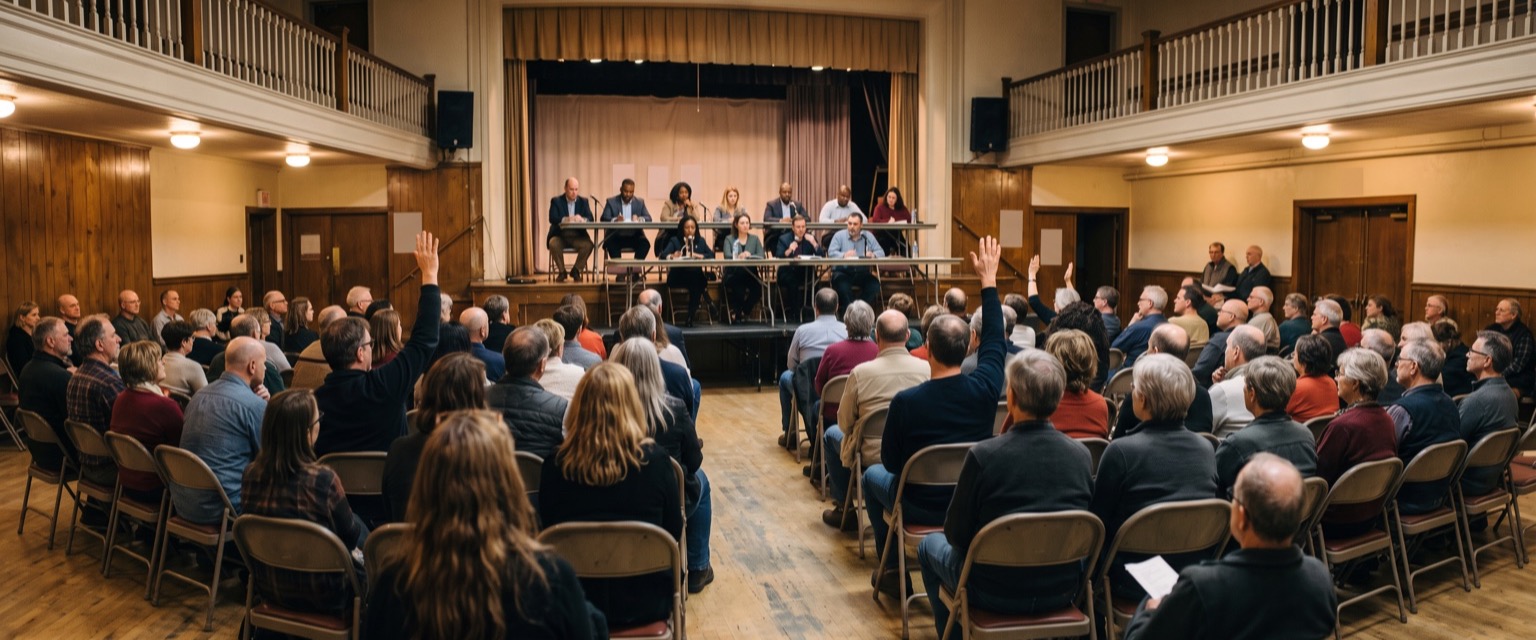
Every candidate will tell you they support small business. The useful questions to ask candidates in the BC election are the ones that cannot be answered with that sentence. Between now and October 24 you will get at least one chance to put a question to the people who want your vote, at an all-candidates meeting, on a doorstep, or by email. This is the list of questions to ask candidates we would bring, why each question matters to a one-to-ten-person firm, and what a real answer sounds like compared with a campaign one.
The test for every answer to these questions to ask candidates. A promise deserves confidence only when it names the legislative or regulatory change, the date, who qualifies, what it costs, where the money comes from, and how success is measured. "Review", "work toward", "when finances allow", "cut red tape" and "get tough" are intentions, not commitments. Score them separately.
ON THIS PAGE
- Questions to ask candidates 1 to 4: taxes
- Questions to ask candidates 5 to 6: payroll and WorkSafeBC
- Questions to ask candidates 7 to 11: permits, leases, safety, liquor, procurement
- Questions to ask candidates 12 to 15: money and accountability
- Questions to ask candidates: how to get an answer in writing
- Quick answers
Questions to ask candidates 1 to 4: taxes
1. Will you permanently repeal, defer, or redesign the professional-services PST, and will that be in legislation? The expansion is paused, not gone. A pause can be lifted after the vote. "We oppose it" is not an answer; "we will repeal section X by date Y" is.
2. Will you exempt machinery, equipment, software and other productivity inputs from PST? This is the bigger PST question for most firms. BC taxes business inputs at 7% with no credit back. Business groups have asked every party for a permanent exemption and none has answered.
3. What exact small-business corporate rate and income ceiling will apply in each year of your term? It is 2% provincially today on the first $500,000. A candidate who promises a cut should say the rate, the year, and the cost.
4. Will you fix the Employer Health Tax cliff above $1.5 million in payroll? Below $1 million, no tax. Above $1.5 million, 1.95% on the entire payroll. Ask whether they will index the thresholds, exempt the first $1 million for every employer, or leave it.

"Repeal, in the first budget, by amending the Provincial Sales Tax Act. Cost: about X per year. Funded by Y."
A campaign answer sounds like: "We have always stood with small business against this tax grab."
A real answer to question 4 sounds like: "Convert the exemption to a true exemption so only payroll above $1 million is taxed, starting tax year 2027."
A campaign answer sounds like: "We will review the EHT."
Questions to ask candidates 5 to 6: payroll and WorkSafeBC
5. Who pays for statutory paid sick days, and will minimum-wage indexing stay automatic? Five employer-paid sick days are law. Minimum wage is $18.25 and rises every June with inflation, without a vote. Both are settled policy unless a party says otherwise, so make them say.
6. Will you return WorkSafeBC's surplus to employers, cut premiums, or keep the surplus? The CFIB has asked for part of the surplus back. It is a direct cash question with a yes or no answer, and it is one of the questions to ask candidates in the BC election that nobody has yet answered.
Why these two together. They are the recurring costs that show up on every pay run. A candidate who cannot say whether they change is not offering you a payroll policy, whatever the slogan says.
Questions to ask candidates 7 to 11: permits, leases, safety, liquor, procurement
7. Which permit and business-licence decisions will have statutory deadlines, and what happens when government misses them? A deadline with no remedy is a suggestion. Ask for both halves.
8. Will you create commercial-tenancy dispute resolution, and what claims, remedies and dollar limits will it cover? The NDP promised lower-cost resolution of landlord disputes in 2024. The Civil Resolution Tribunal still lists no commercial-tenancy stream. Treat it as unfinished until a program exists.
9. What permanent program replaces the security rebate that ended? Over half of BC small firms say crime is worse. The $10.5 million rebate paid out $71,308 in its first three months, was loosened, then ended. Cameras, repairs and deductibles did not.
10. Will liquor-law modernization proceed, with a published date? Promised in 2024 in Ontario-style terms. Not verifiably completed. Restaurants, breweries and event venues should ask for the date.
11. How will small firms get fair access to provincial procurement without excessive certification and bid costs? Provincial buying can help a small firm scale, or lock it out with paperwork. Ask which one their policy produces.

The most effective version of question 7 is your own permit story: the date you applied, the date you opened, and the rent you paid in between. Candidates remember numbers with a face on them.
Municipal or provincial? Business licences, patios, signage and property tax are city hall's, and Vancouver votes on October 17. Provincial candidates can promise benchmarks and funding conditions, not direct control. Ask them which lever they would actually pull.
Questions to ask candidates 12 to 15: money and accountability
12. What are your annual deficit, debt and debt-service targets, and what assumptions support them? The projected deficit is $13.8 billion, debt service about $6.3 billion a year, and there is no published date for balance. Every promise sits on top of that.
13. Which of your promises depend on federal action, economic growth, future surpluses or unspecified reviews? Conditional promises let a party claim compliance later even when nothing changed. Make them list the conditions now.
14. Which of your 2024 promises are being renewed, cancelled or materially changed? The $1,000 household rebate was promised in 2024 and cancelled in February 2025. The 2024 Conservative and Green platforms are the only detailed documents that exist. Ask what still stands.
15. What independent public tracker will report progress, deadlines and actual costs? CBC tracked the NDP's 2017 promises and found most delivered. A party confident in its plan should welcome the same for 2026.
Scoring an answer. Give it one point each for: the specific change, the date, the eligibility, the cost, the funding source, the measure. Six points is a commitment. Three or fewer is a hope. Keep a tally across candidates and the comparison makes itself.
Questions to ask candidates: how to get an answer in writing
- Email every candidate in your riding with three questions, not fifteen. Pick the three that touch your business most. Written answers are quotable; doorstep answers evaporate.
- Go to one all-candidates meeting. Chambers and business improvement associations run them in most ridings in the final two weeks. Bring your permit or payroll example.
- Check the source documents yourself. The Greater Vancouver Board of Trade's 2024 platform comparison is the clearest record of what each party said last time. The CFIB's election page tracks what small firms are asking for in 2026.
- Register and vote. Dates, advance voting and mail-in ballots are at Elections BC. The provincial vote is October 24; Vancouver's local election is October 17.
The full issue map, with where each party stands today and what Budget 2026 already changed, is in our guide to the BC election 2026 for small business.
Quick answers
What are the most important questions to ask candidates in the BC election about small business?
Start with the ones that have yes or no answers: repeal or defer the services PST, exempt equipment from PST, fix the Employer Health Tax cliff, return the WorkSafeBC surplus, and set a date to balance the budget.
How do I tell a real commitment from a campaign line?
A real commitment names the change, the date, who qualifies, the cost, the funding source and the measure of success. Anything phrased as a review, a goal or a condition is an intention.
Which business issues are decided by city hall, not the province?
Business licences, patio and signage rules, local permits and property tax. Vancouver votes on those on October 17, a week before the provincial election.
Where can I find what the parties promised in 2024?
The Greater Vancouver Board of Trade published a side-by-side platform comparison in 2024, and CBC maintained a promise tracker for the previous government. Both are linked above.






Leave A Comment